Moodboard in Seconds: How AI Compressed a 3-Hour Process into 30
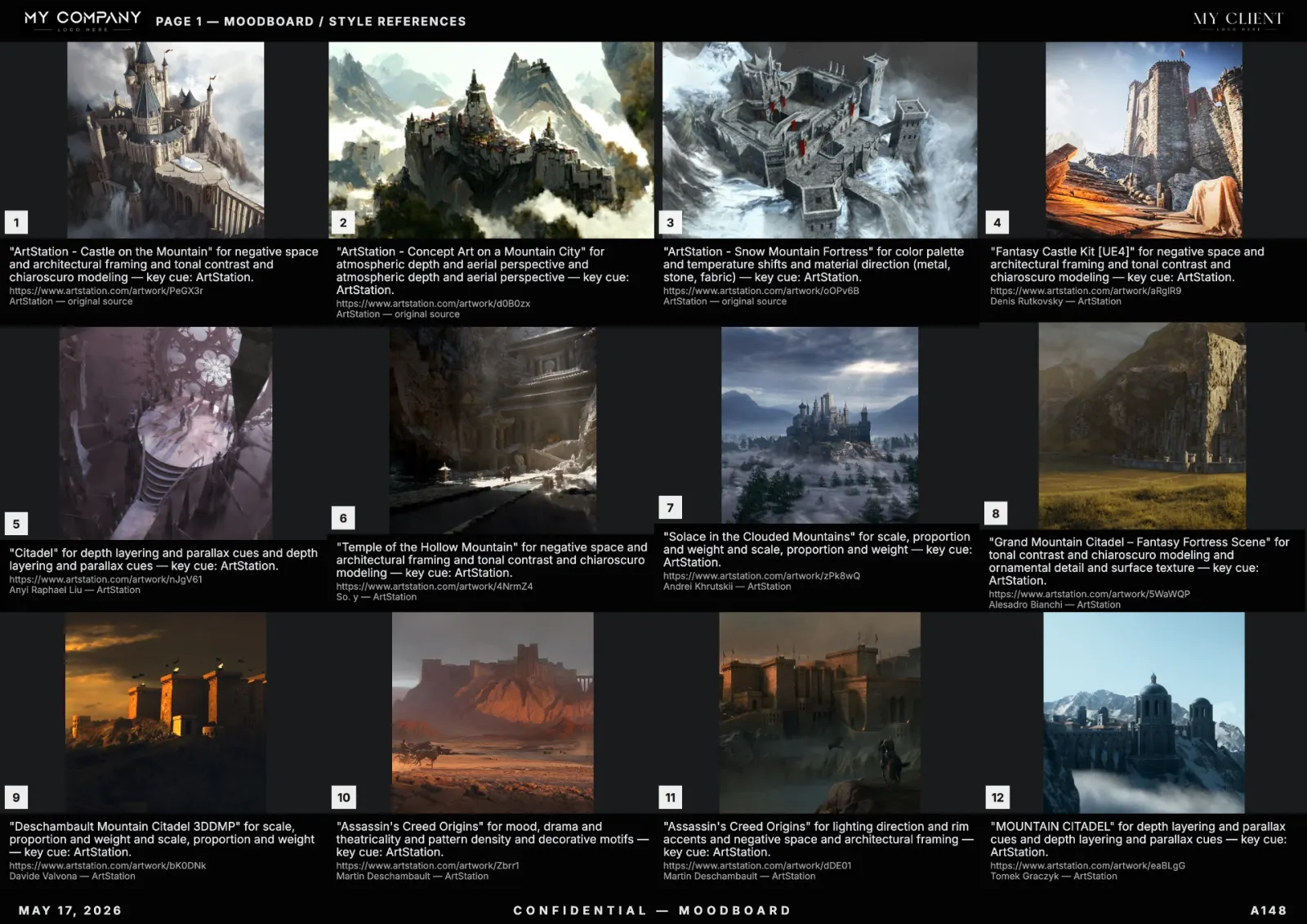
The phrase "moodboard in seconds" sounds like marketing copy. In 2026 it is a technical fact: a properly built AI moodboard pipeline returns 20 to 40 curated, captioned, palette-aware references in 30 to 90 seconds. Here is exactly how, where the seconds are spent, what they replace, and what they cannot.
What used to take three hours
The legacy moodboard process — Google Images plus Pinterest plus museum browsing plus screenshots plus a manual InDesign layout — took an art director two to four hours per direction. Multiply by three directions per pitch, by two pitches per week, and a senior AD spent 30% of their week hunting references. That is the cost AI moodboards removed.
The 30-second pipeline, step by step
- Prompt parse (0.2s) — the prompt is decomposed into subject, mood, era, medium, palette.
- Multi-source search (1–4s) — parallel queries to museum APIs, ArtStation, photography libraries, painting archives.
- Semantic re-rank (2–5s) — a vision model scores how well each candidate matches the prompt.
- Palette re-rank (1–2s) — candidates are re-scored by proximity to the locked palette.
- Caption generation (3–8s) — each kept tile gets a one-line reason.
- Layout composition (1–3s) — tiles are placed on the canvas at correct aspect ratios.
Total: 30 seconds on a fast prompt, 90 seconds on a complex one. For a fuller breakdown of how an AI moodboard creator works under the hood, see our pillar guide.
Where the seconds win matters most
- Pitching three directions on the same deadline — generate three boards in two minutes instead of three afternoons.
- Iterating on client feedback — "darker, less saturated" is a 30-second regeneration instead of a half-day reshoot of the moodboard.
- Onboarding new artists — instead of a written brief, ship a board they can scan in two minutes.
Where seconds still lose to humans
Speed buys you nothing if taste is missing. The 30-second board still needs a human to:
- Decide the palette and exclusions.
- Curate down to 12–18 keepers.
- Write captions as direction notes, not descriptions.
- Pick the studio template.
AI compresses search. It does not compress taste.
The hidden constraint: source quality
The pipeline is only as fast as the source library it pulls from. Museum APIs are slow but license-clean. ArtStation is fast and dense. Photography libraries vary. The best tools pre-cache, parallelize, and fall back gracefully — which is why "moodboard in seconds" only works on a properly engineered backend.
Three workflows the seconds unlock
The pitch sprint
Three labelled directions in 10 minutes total. Used in agency pitches and game studio pre-production.
The live client review
Generate during the call. Iterate on feedback in real time. Sounds gimmicky, sells like crazy.
The brief alignment
Instead of writing a 2-page brief, ship a 12-tile board. The board is the brief. Faster to read, harder to misinterpret.
FAQ
How long does AI take to make a moodboard?
30 to 90 seconds for the generation pipeline. Add 5 to 15 minutes for curation, captions and template. Total: 10–20 minutes from blank to client-ready.
Is a moodboard generated in seconds any good?
The raw generation is research-grade. The board becomes client-grade after 5–10 minutes of curation. See how to make a moodboard fast.
Does AI moodboard generation use my data?
It depends on the tool. RefMood does not train models on user prompts.
Can it generate moodboards from an image?
Modern tools accept both text and image prompts. Image prompts are useful when the brief is visual, not verbal.